The Reuters news staff had no role in the production of this content. It was created by Reuters Plus, the brand marketing studio of Reuters.

PRODUCED BY REUTERS PLUS FOR

With the highest concentration of software developers per capita in the EU, and 80% of the world's top tech companies calling it home, Ireland has built a solid foundation as Europe's software hub – and is ready for the next wave of tech innovation.
Disclaimer: The Reuters news staff had no role in the production of this content. It was created by Reuters Plus, the brand marketing studio of Reuters. To work with Reuters Plus, contact us here.
Invest in Ireland
With skilled talent, supportive incentives and a stable economy,�Ireland is the perfect platform for world-leading companies to scale and grow.
Find out how to Invest in Ireland here.
The Emerald Isle's digital future:
How Ireland became
a software powerhouse


EN
JP
CHOOSE LANGUAGE:


Its cobblestone streets and 12th Century roots make the ancient port of Galway an unlikely location for a tech hub and springboard into the €18 trillion market of the European Union. Yet, with its mix of cutting-edge research institutions, innovative start-ups and a well-educated workforce, Galway is drawing global tech companies to the west of Ireland.
A home for software engineers
This ecosystem has contributed to a tech talent pool that is continually being replenished, says Jon Ross, VP of Product at Zendesk, a California-based software company with its European base in Dublin. The city “is such a hub for big tech companies that you might think ‘if we come to Dublin, we’re going to be competing with all of them, we won’t be able to get good staff’. But I think the opposite is true,” says Ross. “Because we’ve got such a base of well-recognized brands in Dublin, that actually brings qualified people from all over Europe.”
Nowhere in the European Union has as many software developers per capita, according to The State of European Tech, a report published last year. Another study by Sequoia Capital found that capital city Dublin has greater access to AI and data science talent than any other European city. Ireland also boasts the highest level of STEM graduates aged 20-29 per capita in the EU.
Ireland’s tech roots run deep. Apple arrived in Cork in 1980. Microsoft’s Irish operation recently celebrated its 40th anniversary. Half the technology companies Ireland has attracted have been present for more than a decade and a third began investing more than 20 years ago.
Today, there are 106,000 employed in Ireland’s tech sector, trained in specialisms from software engineering to data analysis and cloud computing. Together, they generate exports of €35 billion-a-year. Ireland ranks second, behind China, in global exports of software and IT services.
A time to invest
Investors are seeing the opportunity. Ireland has registered a 37% year-on-year rise in investments in the first half of 2025. The nation’s talent pool and its reputation as a European technology hub are seen as major pull factors. The figures “demonstrate Ireland’s continued attractiveness as a trusted partner and a proven investment location, speaking to our many strengths in areas such as innovation and talent,” says Michael Lohan, CEO of IDA Ireland, the country’s investment promotion agency.
Established tech giants are growing their footprints. IBM, which has been in Ireland for nearly 70 years, is recruiting 800 tech jobs by 2027, including 75 high-skilled software engineers for its R&D operations in Waterford, south-east Ireland. Apple’s Irish workforce has grown to 6,000. Microsoft Ireland is creating 550 new jobs to pioneer AI technologies. Intel is doubling its manufacturing capacity at its Dublin campus with a €17 billion investment. Eight of the ten leading American software companies have bases in Ireland.
Swedish global giant Ericsson arrived in Athlone in 1974 and has since expanded its software campus to house a team of 1,400 engineers. This year it announced investment in a three-year R&D project at the site to improve the efficiency of 5G networks globally. “This €200 million investment, supported by IDA Ireland and the Irish government, is a testament to our commitment to Ireland and confidence in our exceptional talent here,” says Denis Dullea, head of Ericsson’s Athlone site.
Asian companies are seeing opportunities. Trend Micro, a multinational cybersecurity company headquartered in Tokyo, was quick to recognise Ireland’s strengths and 20 years ago set up operations in Cork, which hosts a cluster of cyber firms. “Cork has placed itself firmly on the map as the headquarters for TrendMicro operations in the Europe region and continues to expand in terms of people and functions that we serve here,” says Robert McArdle, director of the forward-looking threat research (FTR) team at Trend Micro.
In specialist areas, such as renewable energy tech, Japanese companies are investing in Ireland. Mitsui & Co has a share of Dublin’s Mainstream Renewable Energy. Tokyo Electric Power (TEPCO) owns a stake in Irish wind farms and Mitsubishi Corporation bought Irish green tech firm ElectroRoute, which is supporting its supply of electricity to AWS data centres.
AI ready
In this environment, where tech is hard-wired into both the economy and national culture, Ireland appears to have prepared for the growth of AI with exceptional perspicacity. It was quick to identify something more than a trend and fast to build infrastructure to adapt for a world-changing technological innovation.
Ireland created an abundant source of AI talent by introducing a pioneering master’s degree in AI back in 2018, based at the University of Limerick. Run in collaboration with the Irish Centre for High End Computing, the program has been developed with more than 20 companies linked to Ireland’s fast-emerging AI sector, including Google and Ericsson.
Around its launch, Paul Sweetman, CEO of AmCham, noted: “Investing in AI skills will produce a pipeline of highly capable experts for this strategically important sector.”
A national AI Strategy followed in 2021, months ahead of OpenAI releasing ChatGPT and sparked the global imagination to the new possibilities in late 2022. Significantly, OpenAI opened a Dublin office in 2023.
Meanwhile, Ireland’s national strategy has pledged to connect all Irish business to gigabit networks by 2028. Dr Patricia Scanlon was appointed as the country’s first AI Ambassador in May 2022, tasked with starting a national conversation on AI.
Such forward planning is paying dividends. Today, 36% of Irish start-ups are embedding AI into their core business models, compared to the European average of 29%, according to a report by Amazon Web Services (AWS), Unlocking Ireland’s AI Potential 2025. The new tech could generate €250 billion to Ireland’s GDP by 2035, according to AI Economy in Ireland 2025, produced by Trinity Business School in collaboration with Microsoft Ireland.
The direction of travel looks set. It will be supported by Ireland’s network of world-class tech research institutes, including CeADAR, the national centre for AI, and Lero, the national software research centre, based in Limerick. Lero is partnering with AI giant Nvidia to support Europe’s first e-sports science research lab.
Ireland is not just waiting for the next technology revolution—it is actively making it happen.
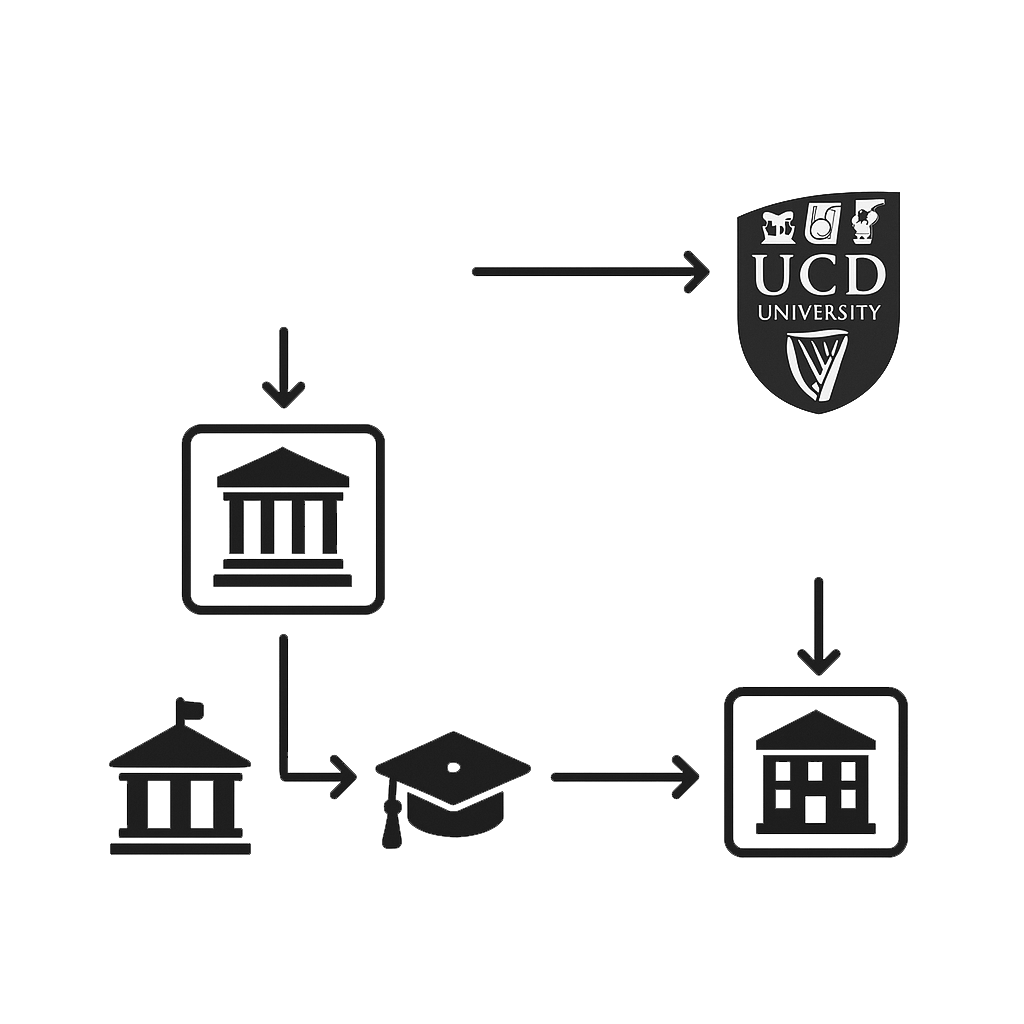
IRELAND'S INNOVATION ECHOSYSTEM
Government
Academia
K-NIBRT
South Korea
NIBRT
University
College
Dublin


JAPAN-IRELAND
BUSINESS RELATIONS
1973
Embassy of Japan opens
8000
Employees
44
Japaneese companies present in Ireland
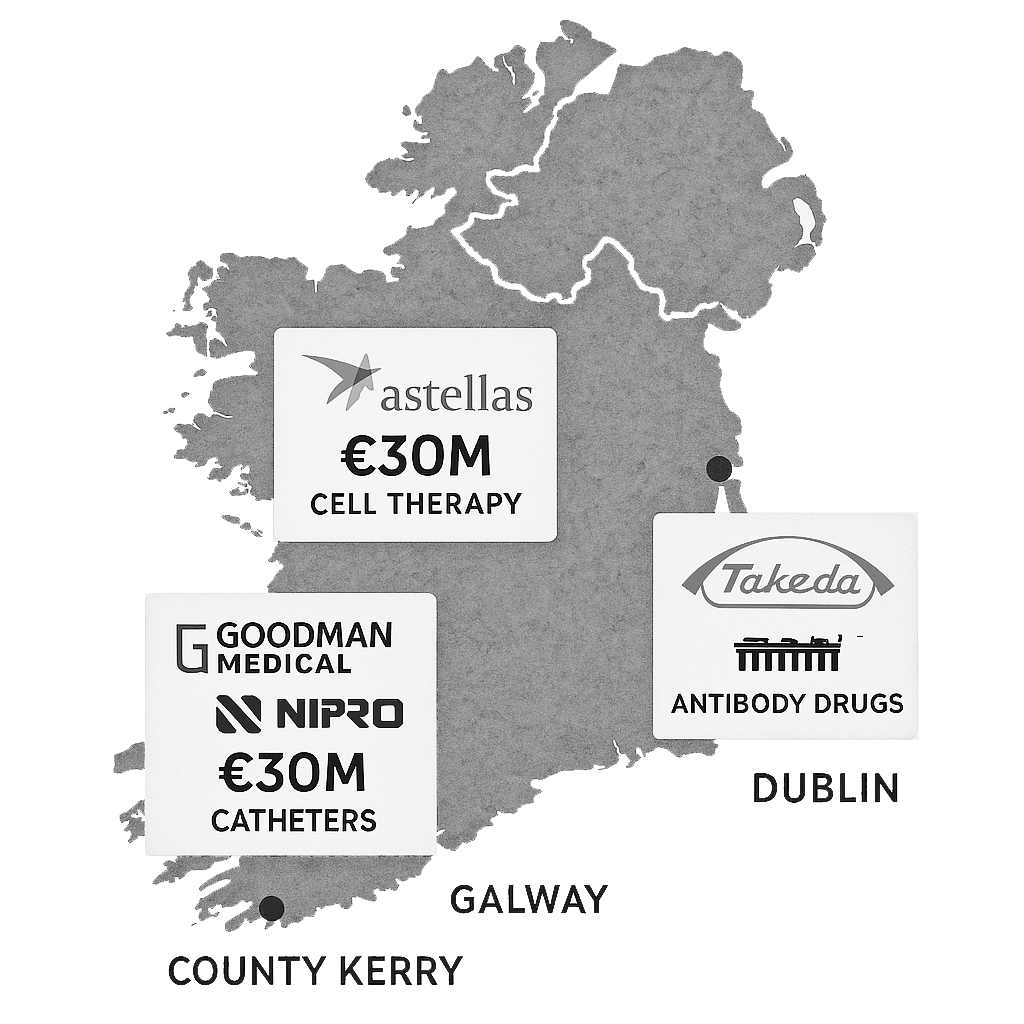
County Kerry
Gallway
Dublin
Something about
Ireland's
Global
Business
Connections
Asian Investment in Ireland
Talent & Workforce
Datavant plans to hire 125 people in a diverse range of engineering roles in Galway

leading global biopharmaceutical companies
13 out of 15
FDI Investments
Our new Global Development Centre in Galway is going to be a critical part of achieving our vision, that every health decision is powered by the right data at the right time in the right format
— Datavant CEO Kyle Armbrester

Ireland is home to 80% of the top 20 global tech companies
973
separate FDI investments
Datavant, one of the world’s leading health data platform companies, opened its global R&D centre in Galway this year, with plans to hire 125 people in a diverse range of engineering roles. The company chose it because of a local abundance of highly experienced tech talent and Ireland’s proximity to Datavant’s European customers.
Datavant CEO Kyle Armbrester, says: “Our new Global Development Centre in Galway is going to be a critical part of achieving our vision that every health decision is powered by the right data at the right time in the right format.”
Galway is the European hub for numerous global software and technology giants, including Germany’s SAP, America's Cisco, HPE, and governance software leader Diligent, and Ireland is home to 80% of the top 20 global tech companies, and the top three enterprise software providers.
50%
Ireland also boasts the highest level of STEM graduates aged 20-29 per capita in the EU
106,000
Employees in Ireland’s tech sector, trained in specialisms from software engineering to data analysis and cloud computing

77,000
new Irish jobs from post-pandemic strategy between 2021-2024


37%
Ireland has registered a 37% year-on-year rise in investments in the first half of 2025
6,000
Apple’s Irish workforce


80%
