This advertiser content has been created and paid for by FUJIFILM Business Innovation Corp. Neither Reuters News nor Reuters Plus, the brand marketing studio of Reuters, were involved/had a role in the production of this content.
Paid for and created by

This advertiser content has been created and paid for by FUJIFILM Business Innovation Corp. Neither Reuters News nor Reuters Plus, the brand marketing studio of Reuters, were involved/had a role in the production of this content.


The formula for unleashing corporate strength
Digital transformation with discernment and execution

CHOOSE LANGUAGE:
EN
HK
JP
KR
TH
TW


他のコンテンツも読む

See other initiatives of
FUJIFILM Business Innovation
他のコンテンツも読む

ビジネス成長への布石~情報利活用の真価に迫る
Small- and medium-sized enterprises (SMEs) make up 98 percent of all businesses in the APAC region – small giants that quietly power the economy. Today, they stand at a critical juncture. As digital technologies like AI reshape the business landscape, the ability to navigate digital transformation has become a key factor in the long-term competitiveness of SMEs. Yet, for many, digital transformation is still anything but straightforward. So, what is required to overcome the challenges they face? To find out, we sat down with Mr. Kikuchi and Mr. Takizawa of FUJIFILM Business Innovation – seasoned experts in the digital transformation of SMEs.
Cultural and structural barriers to digital transformation
For many SMEs, technology is not the only hurdle on the road to digital transformation – cultural and structural impediments can also slow or obstruct the progress. “The challenges are multifaceted,” explains Kikuchi. “They stem from a mix of policies and practices – rigid business processes rooted in long-standing routines, a continued dependence on paper-based workflows, poor localisation in multicultural settings, and a shortage of IT personnel.” Furthermore, each company faces its own unique hurdles. These challenges make it difficult to identify the best solution for any company. “We must have a broad range of potential solutions, determine the optimal combination of them for a specific business, and implement them effectively,” he says. “The ability to both evaluate and execute is key to successful digital transformation.”
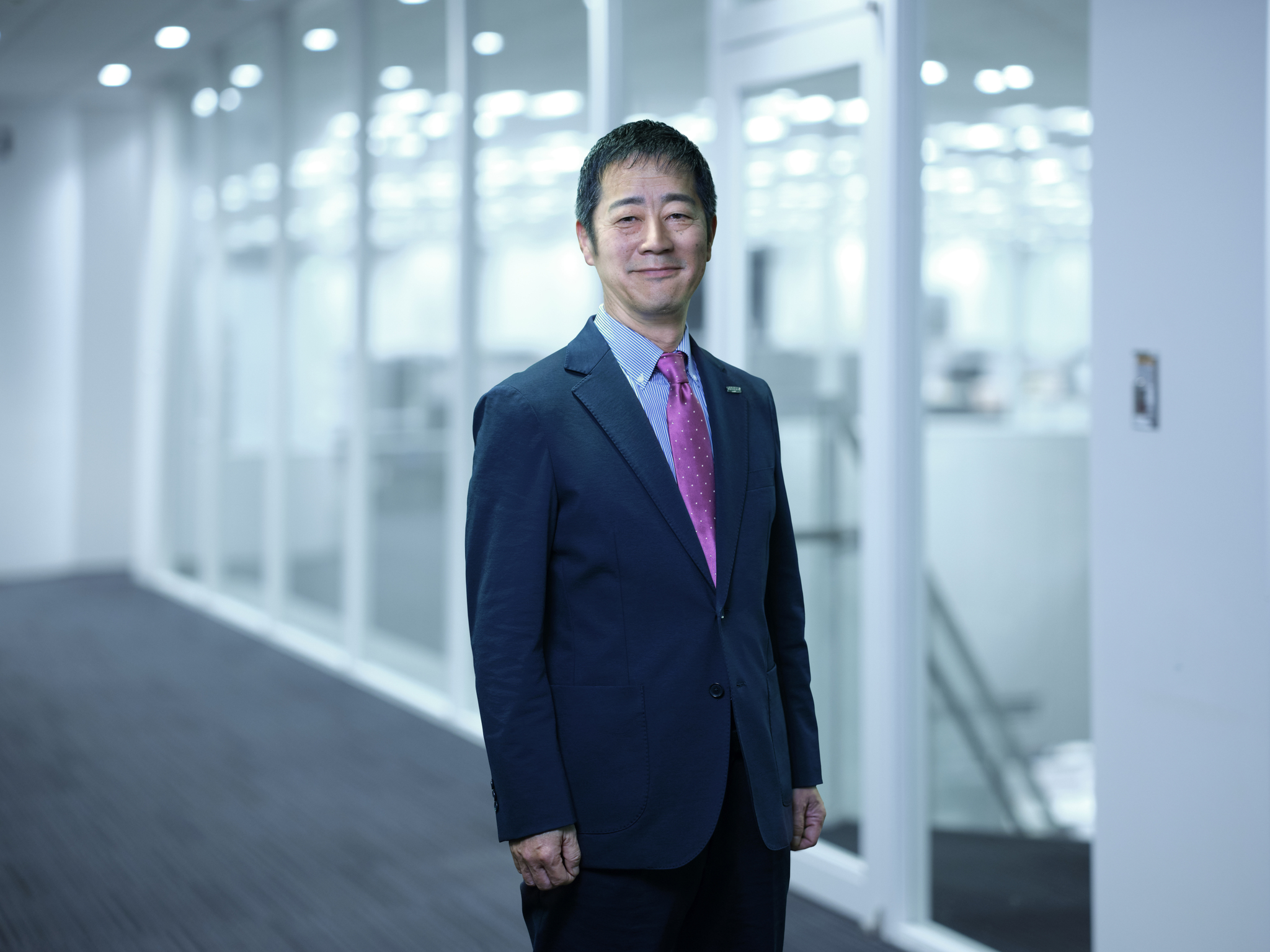
Motoru Takizawa, General Manager,Marketing Business Solution Division of FUJIFILM Business Innovation

What you really need is
advancing corporate digital transformation in the right direction.
“
“
Choosing a solution, not just a product
“Introducing technologies or systems that don’t align with a company’s specific needs can actually reduce productivity,” says Takizawa. While they have a role in digital-transformation solutions, he emphasises that they are merely the means to an end. The actual objective is to steer a company’s digital transformation in the right direction, and ideally, this would occur in four phase.
FUJIFILM Business Innovation Solution Phases
Blurring the line between analogue and digital
So, what steps are required in each of these phases? In Phase 1, we already have at our disposal a familiar yet often overlooked tool: the multifunction printer (MFP). “While MFPs are typically viewed as devices for printing and copying, they actually serve as important entryways for information captured in digital transformation,” explains Takizawa. For companies to progress to the next level, they must be able to digitise large volumes of analogue data quickly and accurately. For those that still rely heavily on paper documents and fax machines, establishing a gateway for the migration of data across the analogue-digital divide is critical. “By using MFPs integrated with cloud services and AI technologies, companies can structure and leverage their data in ways that align seamlessly with their operational workflows,” adds Takizawa. “This is the starting point of digital transformation.”
Shiro Kikuchi, Corporate Vice President of FUJIFILM Business Innovation

We must have a broad range of potential solutions, determine the optimal combination of them for a specific business, and implement them effectively.
“
“
PHASE
1
Moving toward paperless operations and enhancing operational efficiency using multifunction printers and related solutions
PHASE
2
Strengthening IT infrastructure and security for more effective use of information assets
PHASE
3
Optimising business processes and workforce allocation with tools like RPA and general-purpose AI
PHASE
4
Building and leveraging proprietary AI to enhance organisational capabilities
Transforming daily work with digital tools
Phase 3 takes a company to full-scale operational efficiency and AI use. “In this phase, it is essential to create an optimal work environment for employees,” says Takizawa. “That includes integrating digital infrastructure, such as cloud computing, to support seamless work processes.” One tool gaining traction among customers is DocuWorks, developed by FUJIFILM Business Innovation. This desktop software enables employees to convert analogue files to digital, streamlining daily tasks like stamping documents, jotting messages on sticky notes, and attaching them to pages. “By making daily tasks more efficient,” adds Kikuchi, “we not only increase the speed of work but also improve the quality of information-handling across the organisation.
Beyond productivity: The true goal of digital transformation
While these solutions bring clear gains in productivity, their true value lies deeper. “The ultimate goal of digital transformation is not simply to improve efficiency; it’s to fundamentally rethink and redesign business processes,” says Kikuchi. “When companies have a partner like us supporting that process, the restructuring becomes far smoother – and that directly strengthens competitiveness.” Kikuchi calls his team a “one-stop digital-transformation partner” – a collaborator who combines insight gained over many years on the ground in APAC markets with the ability to harness evolving technologies and execute appropriate solutions. For SMEs, such a partner does more than just provide support – it acts as a catalyst for real change. “By working closely with partners like us, listening to what’s happening in the field, and staying proactive in the face of change, companies can achieve true digital transformation and thereby strengthen their core competencies,” Kikuchi conclude.


Managing information assets with an integrated platform
In Phase 4 of digital transformation, the objective is to build an integrated workspace and cloud environment. Many businesses today rely on a variety of communication tools and management systems – often resulting in scattered information assets that can’t be leveraged effectively under a common set of rules. This is where an integrated platform can help. One such solution is FUJIFILM IWpro. “It’s designed to support operations across a wide range of industries and company sizes,” explains Takizawa. Reportedly, this solution has drastically shortened approval times and fully automated tedious data-entry tasks. With a platform that centrally manages all of a company’s information assets, businesses can go a step further: integrating internal data with AI to build customised AI models. “For example, the FUJIFILM IWpro Intelligent Assistant Option* makes it easy to create AI models tailored to your specific operations,” Takizawa notes, “and those models can be seamlessly embedded in your existing IWpro workflows.” His final point is clear: “If AI isn’t easy for businesses to use, its implementation will have little significance."
*Available only in certain regions
Leave IT Infrastructure and Security to the Experts
In Phase 2, it is essential to ensure that the necessary infrastructure is in place to handle information effectively. This is where managed IT services can play a critical role – providing comprehensive support across a company’s IT operations. “These services allow businesses to outsource everything from server management and network monitoring to help-desk support,” explains Kikuchi. “They have rapidly emerged in recent years as a highly effective solution.” Some services even provide end-to-end support, covering everything from system setup to continuous improvement (CI). “Our IT Expert Services, for example, can simultaneously carry out digital transformation in-house, stabilise IT operations, and enhance security,” notes Kikuchi. These services can also free up human resources, allowing a company to strategically reallocate talent to work that generates greater value.
FUJIFILM Business Innovation
Click below for details by country/region
Australia
Hong Kong SAR
Japan
Korea
New Zealand
Singapore
Taiwan
Thailand
Lorem ipsum dolor sit amet, consectetur adipiscing elit. Integer in sodales lectus.